...

.

.

.
. .
. . .
. . . .
. . . . .
. . . . . .
. . . . .
. . . .
. . .
. .
.

jueves, junio 04, 2009

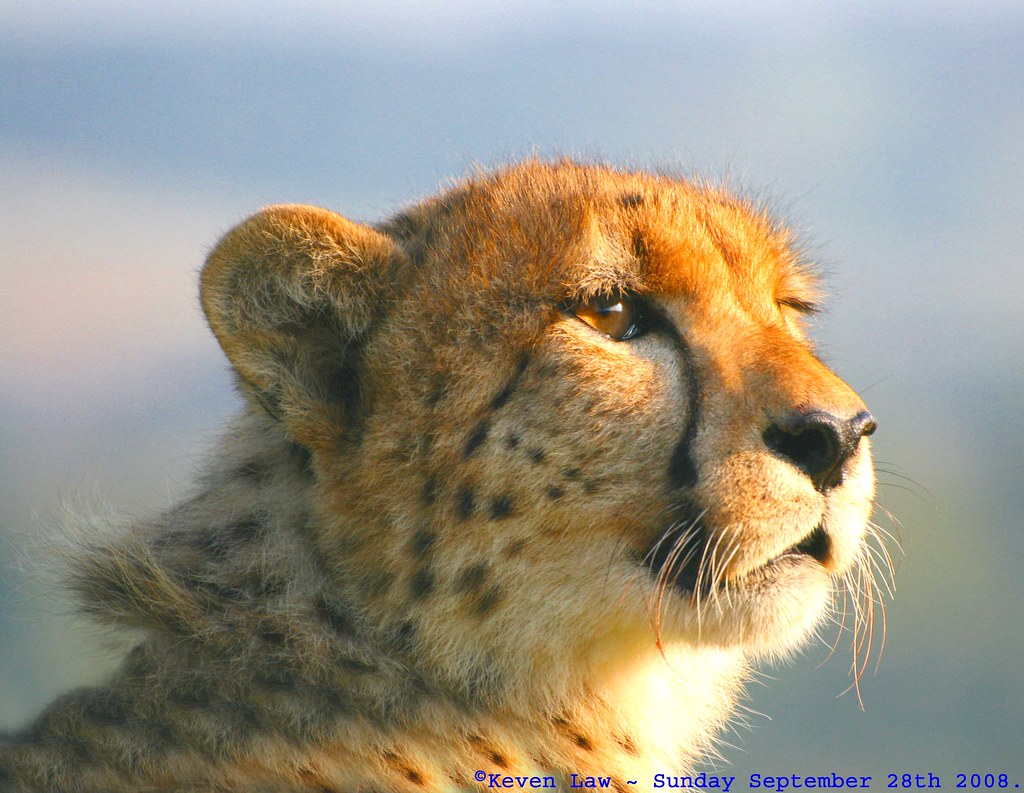
Out for a walk in the Sunshine....


Out for a walk in the Sunshine...., originalmente cargada por law_keven.

In Explore ~ Position Unknown ~ Monday September 29th 2008.

Cheetah - Eagle Heights Wildlife Park, Kent, England - Sunday September 28th 2008.


This was taken when the Cheetah was taken out for a walk in the Kent Sunshine, he was purring like a lil kitty and you got to pet him...which was nice..:O)))

From Wikipedia, the free encyclopedia ~ The cheetah (Acinonyx jubatus) is an atypical member of the cat family (Felidae) that is unique in its speed, while lacking climbing abilities. As such, it is placed in its own genus, Acinonyx. It is the fastest land animal, reaching speeds between 112 kilometres per hour (70 mph) and 123 kilometres per hour (76 mph) in short bursts covering distances up to 460 metres (1,500 ft), and has the ability to accelerate from 0 to 110 kilometres per hour (68 mph) in three seconds, greater than most supercars.

The word "cheetah" is derived from the Sanskrit word chitrakāyaḥ, meaning "variegated body", via the Hindi चीता cītā.

Description ~ The cheetah's chest is deep and its waist is narrow. The coarse, short fur of the cheetah is tan with round black spots measuring from 2 centimetres (0.79 in) to 3 centimetres (1.2 in) across, affording it some camouflage while hunting. There are no spots on its white underside, but the tail has spots, which merge to form four to six dark rings at the end. The tail usually ends in a bushy white tuft. The cheetah has a small head with high-set eyes. Black "tear marks" run from the corner of its eyes down the sides of the nose to its mouth to keep sunlight out of its eyes and to aid in hunting and seeing long distances.

The adult cheetah weighs from 40 kilograms (88 lb) to 65 kilograms (140 lb). Its total body length is from 115 centimetres (45 in) to 135 centimetres (53 in), while the tail can measure up to 84 centimetres (33 in) in length. Males tend to be slightly larger than females and have slightly bigger heads, but there is not a great variation in cheetah sizes and it is difficult to tell males and females apart by appearance alone. Compared to a similarly-sized leopard, the cheetah is generally shorter-bodied, but is longer tailed and taller (it averages about 90 centimetres (35 in) tall) and so it appears more streamlined.

Some cheetahs also have a rare fur pattern mutation: cheetahs with larger, blotchy, merged spots are known as 'king cheetahs'. It was once thought to be a separate subspecies, but it is merely a mutation of the African cheetah. The 'king cheetah' has only been seen in the wild a handful of times, but it has been bred in captivity.

The cheetah's paws have semi-retractable claws (known only in three other cat species - the Fishing Cat, the Flat-headed Cat and the Iriomote Cat) offering the cat extra grip in its high-speed pursuits. The ligament structure of the cheetah's claws is the same as those of other cats; it simply lacks the sheath of skin and fur present in other varieties, and therefore the claws are always visible, with the exception of the dewclaw. The dewclaw itself is much shorter and straighter than other cats.

Adaptations that enable the cheetah to run as fast as it does include large nostrils that allow for increased oxygen intake, and an enlarged heart and lungs that work together to circulate oxygen efficiently. During a typical chase its respiratory rate increases from 60 to 150 breaths per minute. While running, in addition to having good traction due to its semi-retractable claws, the cheetah uses its tail as a rudder-like means of steering to allow it to make sharp turns, necessary to outflank prey who often make such turns to escape.

Unlike "true" big cats, the cheetah can purr as it inhales, but cannot roar. By contrast, the big cats can roar but cannot purr, except while exhaling. However, the cheetah is still considered by some to be the smallest of the big cats. While it is often mistaken for the leopard, the cheetah does have distinguishing features, such as the aforementioned long "tear-streak" lines that run from the corners of its eyes to its mouth. The body frame of the cheetah is also very different from that of the leopard, most notably so in its thinner and longer tail, and unlike the leopard, its spots are not arranged into rosettes.

The cheetah is a vulnerable species. Out of all the big cats, it is the least able to adapt to new environments. It has always proved difficult to breed in captivity, although recently a few zoos have managed to succeed at this. Once widely hunted for its fur, the cheetah now suffers more from the loss of both habitat and prey.

The cheetah was formerly considered to be particularly primitive among the cats and to have evolved approximately 18 million years ago. New research, however, suggests that the last common ancestor of all 40 existing species of felines lived more recently than that - about 11 million years ago. The same research indicates that the cheetah, while highly derived morphologically, is not of particularly ancient lineage, having separated from its closest living relatives (Puma concolor, the cougar, and Puma yaguarondi, the jaguarundi) around five million years ago. These felids haven't changed much since they first appeared in the fossil record.

Reproduction and social life ~ Cheetah cubFemales reach maturity within twenty to twenty-four months, and males around twelve months (although they do not usually mate until at least three years old), and mating occurs throughout the year. A recent study of cheetahs in the Serengeti showed that female cheetahs are sexually promiscuous and often have cubs by many different males.

Females give birth to up to nine cubs after a gestation period of ninety to ninety-eight days, although the average litter size is three to five. Cubs weigh from 150 grams (5.3 oz) to 300 grams (11 oz) at birth. Unlike some other cats, the cheetah is born with its characteristic spots. Cubs are also born with a downy underlying fur on their necks, called a mantle, extending to mid-back. This gives them a mane or Mohawk-type appearance; this fur is shed as the cheetah grows older. It has been speculated that this mane gives a cheetah cub the appearance of the ratel, to scare away potential aggressors. Cubs leave their mother between thirteen and twenty months after birth. Life span is up to twelve years in the wild, but up to twenty years in captivity.

Unlike males, females are solitary and tend to avoid each other, though some mother/daughter pairs have been known to be formed for small periods of time. The cheetah has a unique, well-structured social order. Females live alone except when they are raising cubs and they raise their cubs on their own. The first eighteen months of a cub's life are important - cubs learn many lessons because survival depends on knowing how to hunt wild prey species and avoid other predators. At eighteen months, the mother leaves the cubs, who then form a sibling, or "sib" group, that will stay together for another six months. At about two years, the female siblings leave the group, and the young males remain together for life. 


Share/Save/Bookmark

martes, junio 02, 2009

T E M P L E - Lotus


T E M P L E - Lotus, originalmente cargada por Nagcharan.

Lotus Flowers sold in front of Mahalakshmi Temple in Mumbai

--                                                                     --                                                                 --                --

Nelumbo nucifera, known by a number of names including Indian lotussacred lotusbean of India, or simply lotus. Botanically, Nelumbo nucifera (Gaertn.) may also be referred to by its former namesNelumbium speciosum (Wild.) or Nymphaea nelumbo. This plant is an aquatic perennial. Under favorable circumstances its seeds may remain viable for many years, with the oldest recorded lotus germination being from that of seeds 1300 years old recovered from a dry lakebed in northeastern China.

A common misconception is referring to the lotus as a water-lily (Nymphaea), an entirely different plant as can be seen from the centre of the flower, which clearly lacks the structure that goes on to form the distinctive circular seed pod in the Nelumbo nucifera.[citation needed] It should also be noted that water-lilies come in colors of white to yellow where as the lotus only in hues of pink.[citation needed]

Native to Greater India and commonly cultivated in water gardens, the lotus is the national flower of India and Vietnam.


Plant taxonomy systems agree that this flower is in the Nelumbo genus, but disagree as to which family Nelumbo is in, or whether it should be part of its own unique family and order tree. According to the U S Department of Agriculture, water lilies make up the family Nymphaeaceae of the order Nymphaeales.


http://en.wikipedia.org/wiki/Nelumbo_nucifera


Share/Save/Bookmark

A DUET


a Duet, originalmente cargada por niaxilin.

Lotus flowers. Wat Phra Kaew, Bangkok. Floating in a sea of gold; tiny living oasis.

-------------

The roots of Nelumbo nucifera are planted in the soil of the pond or river bottom, while the leaves float on top of the water surface. The flowers are usually found on thick stems rising several centimeters above the water. The plant normally grows up to a height of about 150 cm and a horizontal spread of up to 3 meters, but some unverified reports place the height as high as over 5 meters. The leaves may be as large as 60 cm in diameter, while the showy flowers can be up to 20 cm in diameter.


Fruit of Nelumbo nucifera; the dried seed cup is commonly used in flower arrangements.

Researchers report that the lotus has the remarkable ability to regulate the temperature of its flowers to within a narrow range just as humans and otherwarmblooded animals do. Dr. Roger S. Seymour and Dr. Paul Schultze-Motel, physiologists at the University of Adelaide in Australia, found that lotus flowers blooming in the Adelaide Botanic Gardens maintained a temperature of 86 to 95 degrees Fahrenheit, even when the air temperature dropped to 50 degrees. They suspect the flowers may be turning up the heat for the benefit of their coldblooded insect pollinators. The study, published in the journal Nature, is the latest discovery in the esoteric field of heat-producing plants. The very few other species known so far to be able to regulate their temperature include Skunk Cabbage and a Philodendron known as Elephant Ear.

The traditional Sacred Lotus is distantly related to, and possesses similar activity as Nymphaea caerulea. Both Nymphaea caerulea and Nelumbo nucifera contain the alkaloids nuciferineand aporphine.


The distinctive dried seed heads, which resemble the spouts of watering cansphoto, are widely sold throughout the world for decorative purposes and for dried flower arranging.

The flowers, seeds, young leaves, and "roots" (rhizomes) are all edible. In Asia, the petals are used sometimes for garnish, while the large leaves are used as a wrap for food. In Korea, the leaves and petals are used as a tisane.Yeonkkotcha (연꽃차) is made with dried petals of white lotus and yeonipcha (연잎차) is made with the leaves. Therhizome (called ǒu () in pinyin Chinesengau in Cantonese, bhe in Hindirenkon (レンコン, 蓮根 in Japanese),yeongeun (연근) in Korean) is used as a vegetable in soups, deep-fried, stir-fried, and braised dishes. Petals, leaves, and rhizome can also all be eaten raw, but there is a risk of parasite transmission (e.g., Fasciolopsis buski): it is therefore recommended that they be cooked before eating.

Lotus rootlets are often pickled with rice vinegar, sugar, chili and/or garlic. It has a crunchy texture with sweet-tangy flavours. In Asian cuisine, it is popular with salad, prawns, seasame oil and/or coriander leaves.

Lotus roots have been found to be rich in dietary fiber, vitamin C, potassium, thiamin, riboflavin, vitamin B6, phosphorus, copper, and manganese, while very low in saturated fat.[citation needed]

The stamens can be dried and made into a fragrant herbal tea called liánhuā cha (蓮花) in Chinese, or (particularly in Vietnam)[citation needed] used to impart a scent to tea leaves. Thelotus seeds or nuts (called liánzĭ, 蓮子; or xian liánzĭ, 鲜莲子, in Chinese) are quite versatile, and can be eaten raw or dried and popped like popcornphool makhana. They can also be boiled until soft and made into a paste, or boiled with dried longans and rock sugar to make a tong sui (sweet soup). Combined with sugar, lotus seed paste becomes one of the most common ingredients used in pastries such as mooncakesdaifuku, and rice flour pudding.

Various parts of the lotus are also used in traditional Asian herbal medicine.

From ancient times the lotus has been a divine symbol in Asian traditions representing sexual purity, a virtue.

Hindus revere it with the gods VishnuBrahma, and the goddesses Lakshmi and Sarasvati. Often used as an example of divine beauty, Vishnu is often described as the 'Lotus-Eyed One'. Its unfolding petals suggest the expansion of the soul. The growth of its pure beauty from the mud of its origin holds a benign spiritual promise. Particularly Brahma and Lakshmi, the divinities of potency and wealth, have the lotus symbol associated with them. In Hindu iconography, deities often are depicted with lotus flowers as their seats.

The lotus plant is cited extensively within Puranic and Vedic literature, for example:

Bhagavad Gita 5.10:
One who performs his duty without attachment, surrendering the results unto the Supreme Lord, is unaffected by sinful action, as the lotus is untouched by water.

This has also taken root in Chinese cultures with a famous statement made by the Confucian scholar Zhou Dunyi:

I love the lotus because while growing from mud, it is unstained.

Borrowing from Hinduism, in Buddhist symbolism the lotus again represents purity of the body, speech, and mind as if floating above the muddy waters of attachment and desire. It is also to be noted that most BuddhistChineseHinduJapanese, amongst other Asian deities are often are depicted as seated on a lotus flower. According to legend, Gautama Buddha was born with the ability to walk and everywhere he stepped, lotus flowers bloomed.

Drawing in turn on these beliefs, the international Bahá'í community adopted this symbolism in the design of the Lotus Temple in New Delhi, India.


http://en.wikipedia.org/wiki/Nelumbo_nucifera


Share/Save/Bookmark

RED STAIRCASE


Red Staircase, originalmente cargada por juank.madrigal.

Inside Pagoda in Lotus Lake
Kaohsiung, Taiwan


Share/Save/Bookmark

LOTUS LAMP/蓮花燈


Lotus lamp/蓮花燈, originalmente cargada por Art Space.

苗栗通宵拱天宮/MiaoLi, Taiwan


Share/Save/Bookmark

PAKAL, LORD OF PALENQUE


Pakal, Lord of Palenque, originalmente cargada por kwbill.

The jade funeral mask of Pakal was part of his mummy and tomb, discovered in 1952.


Share/Save/Bookmark

TUMBA DE PAKAL


Tumba de Pakal, originalmente cargada por 7 facultades.

Palenque Chiapas, MéXICO
Tomb of Pakal, Maya King


Share/Save/Bookmark

THE TOMB OF PAKAL


The Tomb of Pakal, originalmente cargada por rodvictoria.

The Tomb of Pakal in the National Museum of Anthropology in Mexico City.

----                                  ----

K'inich Janaab' Pakal (23 March 603 - 28 August 683) was ruler of the Maya polity of Palenque in the Late Classic period of pre-ColumbianMesoamerican chronology. During a long reign of some 68 years Pakal was responsible for the construction or extension of some of Palenque's most notable surviving inscriptions and monumental architecture.

Before his name was securely deciphered from extant Maya inscriptions, this ruler has been known by an assortment of nicknames and approximations, common ones including Pakal (or Pacal), "Sun Shield""8 Ahau", and (familiarly) as "Pacal the Great".

In modern sources his name is also sometimes appended with a regnal number, to distinguish him from other Janaab' Pakals that either preceded or followed him in the dynastic lineage of Palenque. Confusingly, he has at times been referred to as either "Pakal I" or "Pakal II". The reference to him as Pakal II takes into account that his maternal grandfather (who died in 612) was also named Janaab' Pakal. However, although his grandfather was a personage of ajaw ranking most recent inscriptional interpretations hold that he probably did not himself hold the actual rulership position over the Palenque city-state. When instead the name Pakal I is used, this serves to distinguish him from two later known successors to the Palenque rulership, Upakal K'inich Janaab' Pakal (ruled c. 742, aka "[K'inich Janaab'] Pakal II") and Wak Kimi Janaab' Pakal (aka [Janaab'] Pakal III), the last-known Palenque ruler who acceded in 799.


Pakal ascended the throne at age 12 on July 29615, and lived to the age of 80. The name pakal means "shield" in the Maya language.

Pakal saw expansion of Palenque's power in the western part of the Maya states, and initiated a building program at his capital that produced some of Maya civilization's finest art and architecture.

He was preceded as ruler of Palenque by his mother Lady Sak K'uk'. As the Palenque dynasty seems to have had Queens only when there was no eligible male heir, Sak K'uk' transferred rulership to her son upon his official maturity.

After his death Pakal was succeeded by his son Chan Bahlum II. A younger son, Kan Xul II, succeeded his brother Chan Bahlum II.


After his death, Pakal was deified and said to communicate with his descendants. Pakal was buried within the Temple of Inscriptions. Though Palenque had been examined by archaeologists before, the secret to opening his tomb—closed off by a stone slab with stone plugs in the holes, which had until then escaped the attention of archaeologists—was discovered by Mexican archaeologist Alberto Ruz Lhuillier in 1948. It took four years to clear the rubble from the stairway leading down to Pakal’s tomb, but was finally uncovered in 1952 His skeletal remains were still lying in his coffin, wearing a jade mask and bead necklaces, surrounded by sculptures and stucco reliefs depicting the ruler's transition to divinity and figures from Maya mythology.


That the bones within the tomb are really those of Pakal himself is under debate due to the fact that the analysis of wear on the skeleton’s teeth places the age of the owner at death as 40 years younger than Pakal would’ve been at his death. Epigraphers insist that the inscriptions on the tomb indicate that it is indeed K'inich Janaab' Pakal entombed within, and that he died at the age of 80 after ruling for around 70 years. Some contest that the glyphs refer to two people with the same name or that an unusual method for recording time was used, but other experts in the field say that allowing for such possibilities would go against everything else that is known about the Maya calendar and records of events. The most commonly accepted explanation for the irregularity is that Pakal, being an elite, had access to softer, less abrasive food than the average person so that his teeth naturally acquired less wear [2]. Despite the controversy, it remains one of the most spectacular finds of Maya archeology. A replica of his tomb is found at the National Museum of Anthropology and History in Mexico City.


http://en.wikipedia.org/wiki/Pakal


Share/Save/Bookmark

PAKAL THE GREAT


Pakal the Great, originalmente cargada por rodvictoria.

Pakal was ruler of the Maya polity of Palenque in the Late Classic period of pre-Columbian Mesoamerican chronology.

......                                  ....                                    ....    ....

The large carved stone sarcophagus lid in the Temple of Inscriptions is a famous piece of Classic Maya art. The widely accepted interpretation of the sarcophagus lid is that Pakal is descending into Xibalba, the Maya underworld. Around the edges of the lid are glyphs representing the Sun, the Moon, Venus, and various constellations, locating this event in the nighttime sky. Below him is the Maya water god, who guards the underworld Beneath Pakal are the "unfolded" jaws of a dragon or serpent, into whose mouth Pakal descends. This is a common iconographic representation of the entrance to the underworld. Other examples of this imagery are found in sculpture on Monument 1 "El Rey" and Monument 9 at the Olmec site of Chalcatzingo, Morelos, on Altar 4 at the Olmec site of La Venta, Tabasco, and in recently discovered murals at the Late Preclassic Maya site of San BartoloGuatemala.

Pakal’s tomb has been the focus of attention by some enthusiasts since its appearance in Erich von Däniken's 1968 best seller, "Chariots of the Gods?". Von Däniken reproduced a drawing of the sarcophagus lid (incorrectly labeling it as being from "Copan") and comparing Pacal's pose to that of 1960s Project Mercury astronauts, interpreting drawings underneath him as rockets, and touting it as supposed evidence of extra-terrestrial influence on the ancient Maya.

In the center of that frame is a man sitting, bending forward. He has a mask on his nose, he uses his two hands to manipulate some controls, and the heel of his left foot is on a kind of pedal with different adjustments. The rear portion is separated from him; he is sitting on a complicated chair, and outside of this whole frame, you see a little flame like an exhaust.

Von Däniken's claim is not considered a credible interpretation by any professional Mayanist. For example Ian Grahamresponded, "Well I certainly don't see any need to regard him as a space man. I don't see any oxygen tubes. I see a very characteristically drawn Maya face"


Carved lid of the tomb of K'inich Janaab' Pakal in the Temple of the Inscriptions.


Another example of this carving's manifestation in pseudoarchaeology is José Argüelles' identification of "Pacal Votan," of whom he claims to be an incarnation named "Valum Votan," who will act as a "closer of the cycle" in 2012 (an event that is also significant on Arguelles' "13 Moon" calendar). Daniel Pinchbeck, in his book 2012: The Return of Quetzalcoatl (2006), also uses the name "Votan" in referring to Pakal. However, this name is not used for Pakal byMayanist researchers such as academic archaeologists, epigraphers, and iconographers. Arguelles claims a connection between Pakal and the semi-historical Toltec figure Topiltzin Ce Acatl Quetzalcoatl, but this is not supported by archaeological or epigraphic evidence. New Age interpretations of Pakal's tomb are a cornerstone of contemporaryMayanism.


http://en.wikipedia.org/wiki/Pakal


Share/Save/Bookmark