...

.

.

.
. .
. . .
. . . .
. . . . .
. . . . . .
. . . . .
. . . .
. . .
. .
.

martes, abril 14, 2009

ATRA HASIS


The 18th century BCE Akkadian Atra-Hasis epic, named after its human hero, contains both a creation myth and a flood account and is one of three surviving Babylonian flood stories. The oldest known copy of the epic tradition concerning Atrahasis can be dated by colophon (scribal identification) to the reign of Hammurabi's great-grandson, Ammi-Saduqa (1646–1626 BCE), but various Old Babylonian fragments exist; it continued to be copied into the first millennium. The Atrahasis story also exists in a later fragmentary Assyrian version, first having been rediscovered in the library of Ashurbanipal, but, because of the fragmentary condition of the tablets and ambiguous words, translations had been uncertain.

W. G. Lambert and A. R. Millard, Cuneiform Texts from Babylonian Tablets in the British Museum, London (1965) published many additional texts belonging to the epic, including an Old Babylonian copy (written around 1650 BCE) which is our most complete surviving recension of the tale. These new texts greatly increased knowledge of the epic and they served as the foundation for the first English translation of the Atrahasis epic in something approaching entirety, by Lambert and Millard (Atrahasis: The Babylonian Story of the Flood, Oxford, 1969). A further fragment has been recovered in Ugarit.

The surviving Atrahasis epic is written on three tablets in Akkadian, the language of ancient Babylon.

Tablet I contains a creation myth about the Sumerian gods Anu, Enlil, and Enki, gods of sky, wind, and water, "when gods were in the ways of men" according to its incipit. Following the casting of lots, heaven is ruled by Anu, earth by Enlil, and the freshwater sea by Enki. Enlil assigned junior divines to do farm labor and maintain the rivers and canals, but after forty years the lesser ones rebelled and refused to do hard labor. Instead of punishing the rebels, Enki, who is also the kind, wise counselor to the gods, suggested that humans be created to do the work. The mother goddess Mami is assigned the task of creating humans by shaping clay figurines mixed with the flesh and blood of the slain god Geshtu-e, "a god who had intelligence" (his name means "ear" or "wisdom"). All the gods in turn spit upon the clay. After ten months, a specially made womb breaks open and humans are born. Tablet I continues with legends about overpopulation and plagues. Atrahasis is mentioned at the end of Tablet I.

Tablet II begins with more overpopulation of humans and the god Enlil sending first famine and drought at formulaic intervals of 1200 years to reduce the population. In this epic Enlil is depicted as a nasty capricious god while Enki is depicted as a kind helpful god, perhaps because priests of Enki were writing and copying the story. Tablet II is mostly damaged, but ends with Enlil's decision to destroy mankind with a flood and Enki bound by an oath to keep the plan secret.

Tablet III of the Atrahasis Epic contains the flood story. This is the part that was adapted in the Epic of Gilgamesh, tablet XI. Tablet III of Atrahasis tells how the god Enki warns the hero Atrahasis ("Extremely Wise") of Shuruppak, speaking through a reed wall (suggestive of an oracle) to dismantle his house (perhaps to provide a construction site) and build a boat to escape the flood planned by the god Enlil to destroy mankind. The boat is to have a roof "like Apsu" (a fresh water marsh next to the temple of Enki), upper and lower decks, and to be sealed with bitumen. Atrahasis boards the boat with his family and animals and seals the door. The storm and flood begin. Even the gods are afraid. After seven days the flood ends and Atrahasis offers sacrifices to the gods. Enlil is furious with Enki for violating his oath. But Enki denies breaking his oath and argues: "I made sure life was preserved." Enki and Enlil agree on other means for controlling the human population.

The Epic of Gilgamesh is an epic poem from Ancient Mesopotamia and is among the earliest known works of literary fiction. Scholars believe that it originated as a series of Sumerian legends and poems about the mythological hero-king Gilgamesh, which were gathered into a longer Akkadian poem much later; the most complete version existing today is preserved on 12 clay tablets in the library collection of the 7th century BCE Assyrian king Ashurbanipal. It was originally titled He who Saw the Deep (Sha naqba īmuru) or Surpassing All Other Kings (Shūtur eli sharrī). Gilgamesh might have been a real ruler in the late Early Dynastic II period (ca. 27th century BCE).

The essential story revolves around the relationship between Gilgamesh, who has become distracted and disheartened by his rule, and a friend, Enkidu, who is half-wild and who undertakes dangerous quests with Gilgamesh. Much of the epic focuses on Gilgamesh's thoughts of loss following Enkidu's death. It is about their becoming human together, and has a high emphasis on immortality. A large portion of the poem illustrates Gilgamesh's search for immortality after Enkidu's death.

The epic is widely read in translation, and the hero, Gilgamesh, has become an icon of popular culture.

http://en.wikipedia.org/wiki/Atra-Hasis

http://en.wikipedia.org/wiki/Epic_of_Gilgamesh


Share/Save/Bookmark

viernes, abril 10, 2009

APRIL - TO OPEN - MONAD - MEME - モナド


The derivation of the name (Latin Aprilis) is uncertain. The traditional etymology from the Latin aperire, "to open",in allusion to its being the season when trees and flowers begin to "open", is supported by comparison with the modern Greek use of ἁνοιξις (opening) for spring. Since most of the Roman months were named in honor of divinities, and as April was sacred to Venus, the Festum Veneris et Fortunae Virilis being held on the first day, it has been suggested that Aprilis was originally her month Aphrilis, from her Greek name Aphrodite (Aphros), or from the Etruscan name Apru. Jacob Grimm suggests the name of a hypothetical god or hero, Aper or Aprus.

The Anglo-Saxons called April Oster-monath or Eostur-monath


Share/Save/Bookmark

viernes, abril 03, 2009

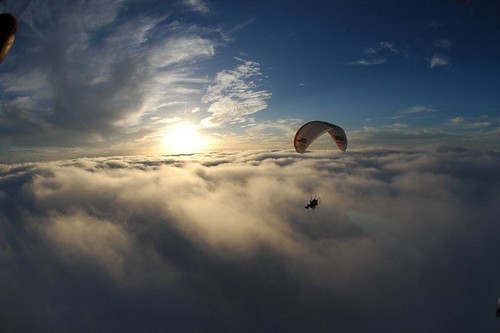
FLYPA 2005 - PARAMOTOR

Autor: José Mª Siverio


Share/Save/Bookmark

THE FLIGHT OF ICARUS / EL VUELO DE ÍCARO


The flight of Icarus / El vuelo de Ícaro, originalmente cargada por Manuel Atienzar.

Paramotor is a generic name for the propulsive portion of a powered paraglider(PPG). It consists of a frame that combines the motor, propeller, harness (with integrated seat) and cage. It provides two attachment points for the risers of a paraglider wing that allows for powered flight.

The term was first used by Englishman Mike Byrne in 1980 and popularized in France around 1986 when La Mouette began adapting power to the then-new paraglider wings.

Pilots who fly these engage in paramotoring, also known as powered paragliding.

Engines used are almost exclusively small two-stroke types, between 80cc and 350cc, that burn mixed gasoline and oil. These engines are favored for their high output power and light weight. At least one manufacturer is producing a 4-stroke model and electrically powered units are on the horizon. Csaba Lemak created the first electric PPG, flying it first on June 13, 2006. Flight duration for electrics is considerably shorter.

The pilot controls thrust via a hand-held throttle and steers using the paraglider's brake toggles similar to sport parachutists.

http://en.wikipedia.org/wiki/Paramotor


Share/Save/Bookmark

AN EARTH VIEW FROM THE SKY - YANN ARTHUS - BERTRAND


Gardens at the Château of Vaux-le-Vicomte, Maincy, Seine-et-Marne, France (48°34’N, 2°43’E).

"The Turkish carpets"-decorative gardens of boxwood hedges-of the château of Vaux-le-Vicomte have been drawn by the landscaper-architect Achille Duchêne in the erli twentieth century. Designed for Nicolas Fouquet, minister of finance, the château was built in five years by approximately 18,000 workers. The garden, set off by several lakes and fountains, is 8,000 feet (2,500 m) long, which required the destruction of two hamlets. Fouquet invited the young king Louis XIV to visit in 1661; offended by the splendor of his subject’s abode, the king ordered an investigation of Fouquet and had him arrested. Le Nôtre, the gardens architect, was assigned the direction of the royal parks and gardens. He designed other gardens ? la française" for the châteaux of Saint-Germain-en-Laye, Saint-Cloud, and Fontainebleau, but his masterpiece remains the gardens of Versailles, the palace of the Sun King himself.


The largest plant maze in the world, at Reignac-sur-Indre, Indre-et-Loire Department, France (47°13’N, 0°54’E).

In 1996, the year the largest plant maze in the world was created at Reignac-sur-Indre in Touraine, 85,000 visitors came to admire and lose themselves in the middle of its 4-hectare (10-acre) expanse. Each year, a maze of corn or sunflowers emerges from the ground over the summer, is harvested in the autumn, and then reappears the following year in a different form, thanks to a well-proven technique of sowing and marking out. This site takes its inspiration from an older tradition in the art of landscaping. During the Renaissance, Italian gardens spawned an abundance of mazes in which people could walk, get lost, hatch plots, and exchange gossip. This lightheartedness somewhat dispelled the sacred and sometimes threatening character of the great old labyrinths associated with Gothic cathedrals and with the Minotaur in Greece, or further back still the hundreds of stone labyrinths known as Troy Towns,» which are scattered along the shores of the Baltic. Were they used for sun rituals, for dancing, as Stations of the Cross, for initiation rites? The modern maze retains a little of the symbolic mystery attached to the Streets of Jerusalem» and the Walls of Jericho.»


River in the marshes, delta of Okavango, Botswana (18°45’ S - 22°45’ E).

http://www.yannarthusbertrand.com/v2/home_es.htm


Share/Save/Bookmark

YANN ARTHUS - BERTRAND


Yann Arthus-Bertrand, originalmente cargada por ionbulgar.

Yann Arthus-Bertrand (born 13 March 1946) is a renowned and internationally recognised French photographer. He originally specialised in animal photography but later turned to aerial photography of subjects in many locations across the world. He has produced over 60 books of his landscape photographs taken from helicopters and balloons. Yann Arthus-Bertrand's work has been frequently published in National Geographic magazine.

His works have both political and aesthetic connotations, and have been exhibited in public spaces worldwide. Arthus-Bertrand is a member of the "Académie des Beaux-Arts de l'Institut de France".

In 1991, he founded the Altitude Agency in Paris, a photographic library that specializes in aerial photography. It is the only one of its kind. In 2000, Arthus-Bertrand created an exhibition with a collection of 100,000 photographs taken in 76 countries which make up his Earth from the Air exhibit. Some of these have been published in his book 365 days: Earth from the Air and exhibited in London, Singapore, Poland, The Netherlands, Finland and elsewhere.

One of Arthus-Bertrand's best-known photographs is of the 'heart' of Voh in New Caledonia, which he has used as the cover of several of his books: The Earth from the Air and Earth from Above.

http://en.wikipedia.org/wiki/Yann_Arthus-Bertrand


http://www.yannarthusbertrand.com/v2/home_es.htm


Share/Save/Bookmark